 License: 1143915
An automatic gate is a system, not a single machine. At its core, an automatic gate combines a gate operator (the motor), a control board (the brain), safety sensors, an access control device, and remotes or keypads that all work together to open and close the gate on command. When you press a remote or enter a code, the control board signals the operator to move the gate while the safety sensors watch the path for people, cars, or pets. If any one part fails, the whole gate can stop working. If your gate is stuck or acting up anywhere in the Bay Area, call (650) 910-6090 for help any time, day or night.
Below we break down each part of an automatic gate, the two main gate styles, the operator options, and how a full cycle runs. Whether you have a driveway gate in San Jose or a rolling gate in Santa Clara, the core parts are the same.
The Main Parts of an Automatic Gate
Every automatic gate is built from the same basic building blocks. Understanding these parts makes it much easier to know what went wrong when the gate stops moving. Here are the components that make an automatic gate work:
- Gate operator (motor): the powered unit that physically pushes, pulls, or slides the gate.
- Control board: the logic board that reads your commands and tells the operator what to do.
- Safety sensors: photo-eyes and safety edges that stop or reverse the gate to prevent injury or damage.
- Access control: the keypad, callbox, card reader, phone entry, or remote you use to trigger the gate.
- Remotes and a receiver: the handheld clickers and the antenna that picks up their signal.
- Power supply: an AC transformer, often paired with a battery backup and sometimes a solar panel.
- Loop detectors: wire sensors in the driveway that detect a vehicle to open the gate on exit or hold it open.
- The gate panel and hardware: the gate itself plus hinges, rollers, track, and posts that carry the weight.
Swing Gates vs. Slide Gates
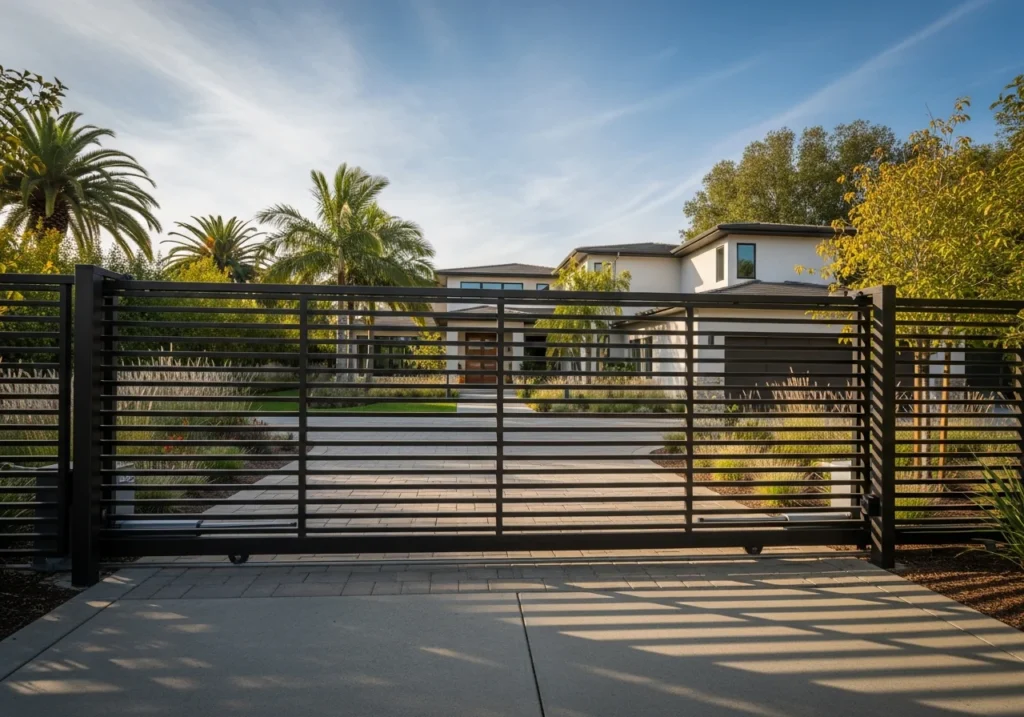
The first thing that shapes how a gate works is its style. Swing gates hinge open like a large door, using either a single panel or two panels that meet in the middle. Slide gates roll sideways across the driveway on a track or on cantilever rollers. Your driveway decides which style fits best: swing gates need clear space to open, while slide gates work well on slopes or tight lots where there is no room to swing.
Gate Types and Operator Types at a Glance
The chart below shows the common gate and operator types you will see across the South Bay, how each one works, and where it fits best.
| Type | How it works | Best for |
|---|---|---|
| Swing gate | Hinged panels swing open like a door, driven by an arm or ram operator | Level driveways with room to swing inward or outward |
| Slide gate | A single panel rolls sideways on a V-track or on cantilever rollers | Sloped driveways or tight lots with no swing room |
| Hydraulic operator | Fluid pressure drives the arm for smooth, strong movement | Heavy gates and high-traffic properties |
| Electromechanical operator | An electric motor and gears move the gate | Most homes; lower cost and easy to service |
| Above-ground operator | Mounts beside the gate post where it is visible and easy to reach | Simple installs and quick repair access |
| Underground operator | Buried at the hinge so it stays hidden from view | Ornamental gates where clean looks matter |
Gate Operators: Hydraulic vs. Electromechanical
The operator is the muscle of the gate. Electromechanical operators use an electric motor and gears; they cost less, are common on homes, and are simple to service. Hydraulic operators use pressurized fluid for smooth, powerful motion that handles heavy gates and heavy use. Operators also differ by mounting: above-ground models sit beside the gate for easy repair access, while underground models are buried at the hinge for a cleaner look. Common brands you will see in the Bay Area include LiftMaster, DoorKing, FAAC, and Viking.
The Control Board: The Brain of the Gate
The control board is the small circuit board inside the operator that runs everything. It receives the signal from your remote, keypad, or callbox, then decides whether to open, close, hold, or reverse the gate. It also reads the safety sensors and loop detectors and follows the timing you set, such as how long the gate stays open before closing on its own. When a gate behaves strangely, opening at random or refusing a valid code, the control board or its wiring is often the cause. Professional gate repair starts with testing the board and its inputs before replacing any parts.
Power: AC, Solar, and Battery Backup
Most automatic gates run on standard AC power fed to a transformer inside the operator. That power charges a set of backup batteries so the gate keeps working through a short outage. Many systems can also be set to open automatically when power is lost, and every gate has a manual release key so you can move it by hand in an emergency. In sunny Bay Area yards where running a power line is hard, a solar panel is often added to keep the batteries charged without a wired connection.
Safety Devices and UL 325
Safety is not optional on a powered gate. Photo-eyes send an invisible beam across the opening; if a car, person, or pet breaks the beam, the gate stops and reverses instead of closing. Safety edges are pressure-sensitive strips that reverse the gate the moment they touch an object. In the United States these features are required by UL 325, the safety standard for automatic gate operators. A gate built to UL 325 is safer for your family and far less of a liability, and its sensors should be tested regularly.
Access Control: How You Get In and Out
Access control is how the gate knows to let someone through. Homeowners usually use a handheld remote or a keypad with a PIN code. Businesses and gated communities often add an intercom or callbox, a card or fob reader for staff, or phone entry that rings your cell phone and opens the gate when you answer. For leaving the property, a loop detector buried in the driveway senses your vehicle and opens the gate automatically. Because these devices are wired to the control board, an access problem usually needs hands-on automatic gate repair to trace the fault.
A Full Open-and-Close Cycle, Step by Step
Here is what happens in a normal cycle. First, you send a command with a remote, keypad, callbox, or loop detector. The receiver passes that signal to the control board, which confirms it is valid and tells the operator to move, so the motor swings or slides the gate open. The gate then holds open for the time you set. When that timer ends, the board checks the photo-eyes to make sure the path is clear, then signals the operator to close. If anything crosses the beam during closing, the safety sensors stop the gate and reverse it.
Automatic gate operators must meet federal UL 325 safety standards; the Door & Access Systems Manufacturers Association (DASMA) publishes gate operator guidance.
Frequently Asked Questions
How do automatic gates work without power?
Most automatic gates have a battery backup inside the operator that keeps the gate running through a short outage. Many systems can also be set to open automatically when power is lost, and every gate has a manual release key so you can move it by hand. In sunny Bay Area yards, a solar panel is often added to keep those batteries charged.
Are automatic gates safe for children and pets?
Yes, when they are set up to UL 325 standards. Photo-eyes stop and reverse the gate if something crosses its path, and safety edges reverse the gate the moment they touch an object. These devices should be tested regularly to make sure they still respond correctly.
How long does an automatic gate operator last?
A quality gate operator usually lasts 10 to 15 years with regular maintenance. Lifespan depends on how often the gate cycles, the weather, and whether the gate itself stays in good alignment. Worn rollers, dragging hinges, or a misaligned gate will shorten operator life.
Can I open my automatic gate with my phone?
Yes. Many modern control boards and callboxes support phone entry, so you can open the gate from a smartphone app or take a call from a visitor standing at the gate. This is popular for rentals, offices, and gated driveways across the South Bay.
What is UL 325 and why does it matter?
UL 325 is the safety standard for automatic gate operators in the United States. It requires features like photo-eyes and entrapment protection so the gate cannot close on a person, car, or pet. A gate that meets UL 325 is both safer and much less of a liability.
How much does an automatic gate cost in the Bay Area?
A new automatic gate operator typically runs from about $1,500 to $5,000 installed, depending on gate size, operator type, and the access controls you choose. Repairs usually cost less. These are typical 2026 ranges; call (650) 910-6090 for an exact quote.
Get Expert Gate Help in the Bay Area
One Stop Garage Doors & Gates is a family-owned, licensed (CSLB #1143915), bonded, and insured company serving San Jose, Santa Clara, Sunnyvale, Cupertino, Campbell, Los Gatos, Milpitas, Mountain View, and the wider South Bay and Peninsula. We repair and install driveway and automatic gates, and we answer the phone 24/7. Call (650) 910-6090 for straight answers and an exact quote on your gate.
Need a Garage Door or Gate Fixed Today?
One Stop Garage Doors & Gates offers same-day service across San Jose, Santa Clara & the South Bay — licensed, upfront pricing, no surprise fees.
Call (650) 910-6090Schedule Online